
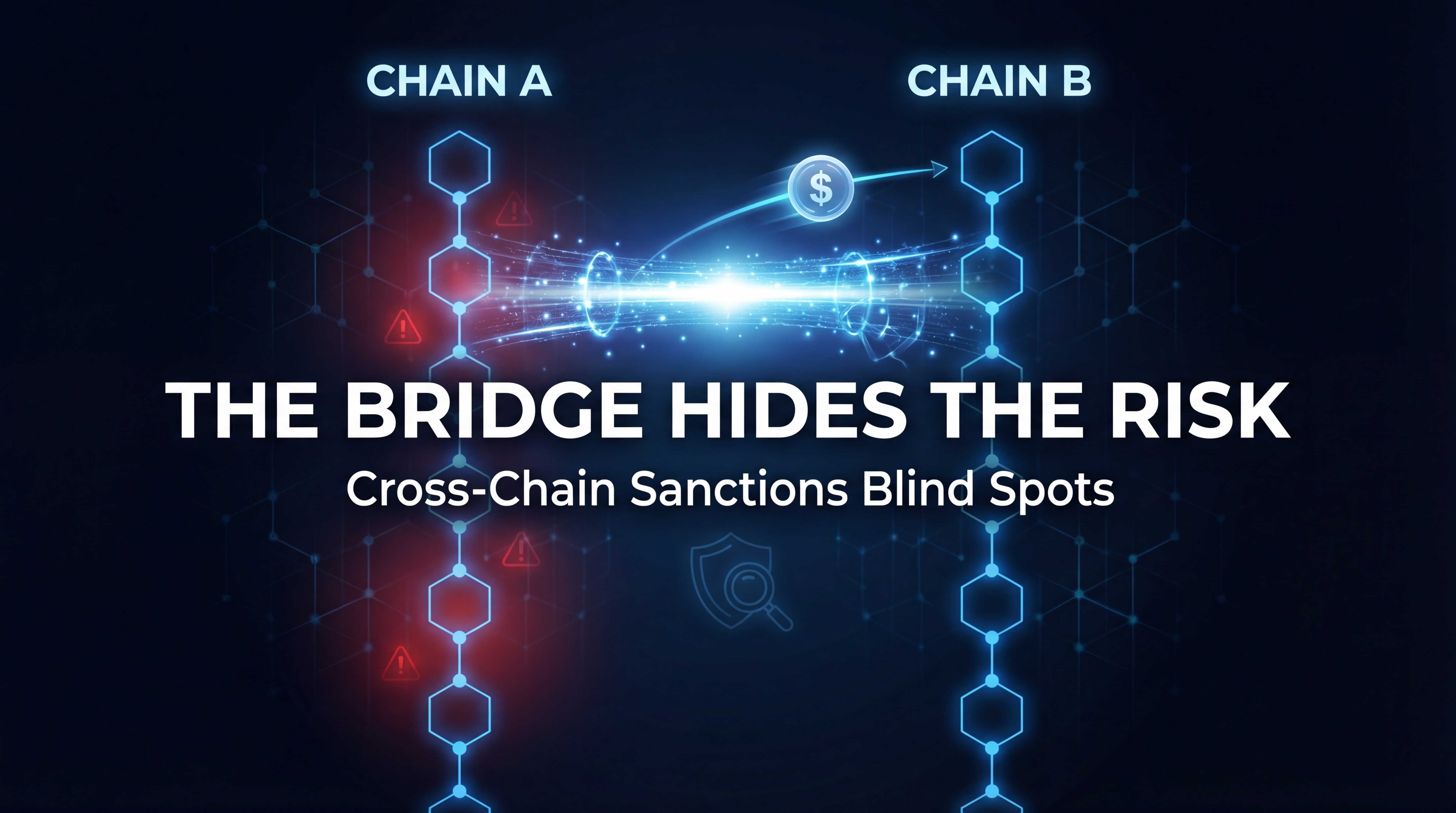
If your sanctions monitoring still treats each blockchain like a separate universe, stablecoins can quietly turn that assumption into your biggest blind spot.
Stablecoins move like traditional fiat currency.
They feel familiar to treasury teams.
They settle inside a digital currency wallet instead of a bank account.
(If you want a quick baseline on terminology, see “Cryptocurrencies, Tokens, and Stablecoins”: https://hindsight.vip/blog/cryptocurrencies-tokens-and-stable-coins)
That familiarity is exactly what makes them powerful — and dangerous in fragmented compliance environments.
This is not just a blockchain analytics issue.
It is an OFAC compliance architecture issue.
When you look chain-by-chain, you do not lose data.
You lose continuity.
And under OFAC jurisdiction, continuity is what determines whether U.S. persons are inadvertently dealing in blocked property, interacting with blocked persons, or facilitating prohibited trade.
Our goal here is simple: make the sanctions risk story readable across networks.
Learn more about the “readability” thesis here:
- How Blockchain Visualization Helps Simplify Complex Data: https://hindsight.vip/blog/how-blockchain-visualization-helps-simplify-complex-data
- Clear Visuals: Easily See Blockchain Activity at a Glance: https://hindsight.vip/blog/clear-visuals-easily-see-blockchain-activity-at-a-glance
The Enterprise Problem: Chain-by-Chain Monitoring Creates False Comfort
Most sanctions list screening programs were designed for centralized rails where:
- The payment system is known.
- Counterparties are identifiable.
- The transaction context lives in one environment.
Digital currency transactions do not behave that way.
Context fragments across:
- Digital currency wallet infrastructure
- Bridge contracts
- Liquidity pools
- Other payment processors
- Multiple chains
If your sanctions list search tool only reviews one network at a time, you can miss:
- Continuity — that funds on Chain B originated from blocked virtual currency on Chain A.
- Intent — that the bridge hop reflects deliberate chain hopping by malicious actors.
- Exposure — that the same value moved through multiple venues that each appear compliant in isolation.
Under OFAC regulations, a bridge does not reset exposure.
It relocates it.
More blockchain transparency does not automatically equal stronger OFAC compliance obligations.
You do not just need data.
You need narrative continuity.
If your team is exploring enterprise-grade, multi-network monitoring, start here: enterprise on-chain monitoring — [LINK NOT FOUND IN INDEX]
Same Flow, Two Chains, One OFAC Risk Story
Think of this not as separate digital currency transactions — but as a single compliance event.
Chain A — Origin
A digital currency wallet associated with a high-risk cluster sends funds to an intermediary address.
On Chain A, that intermediary may appear ordinary:
- Limited transaction history
- No direct SDN match
- No obvious sanctions list screening trigger
It may not appear on digital currency address listings tied to blocked persons.
But appearance is not clearance.
(Why visual context matters in investigations: Hindsight’s Approach to Blockchain Visualization: https://hindsight.vip/blog/hindsights-approach-to-blockchain-visualization)
Bridge — The Context Break
The intermediary interacts with a bridge contract.
Funds are locked, burned, or minted (depending on mechanics). A wrapped version appears on another network.
This is where most risk-based compliance program workflows fragment.
Because:
- The original unique alphanumeric identifier (wallet address) does not carry forward.
- Screening tools often restart the risk clock.
- Analysts switch dashboards.
If your sanctions list search tool treats this as a new transaction, you have just created a blind spot inside OFAC jurisdiction.
Chain B — Destination
On Chain B, the relevant digital currency appears.
Funds may move into:
- An exchange
- A liquidity pool
- A payment processor
- A decentralized protocol such as Dash or Neo-based infrastructure
- Other payment processors operating cross-border
The value is the same.
The exposure may be the same.
But the story now looks disconnected.
This is how blocked virtual currency can appear “clean enough” downstream.
What You Miss When You Look Chain-by-Chain
1) Second-Order Exposure to Blocked Persons
Many programs focus on direct SDN hits.
“Did we process transactions directly involving a blocked person?”
Cross-chain behavior creates second-order exposure:
- You may not directly transact with a listed entity.
- You may transact with infrastructure closely downstream from blocked persons or country-related sanctions clusters (including Russia-related sanctions).
Under OFAC requirements, indirect dealings can still trigger compliance obligations — especially when a risk-based approach would reasonably detect the linkage.
Fresh wallet does not mean fresh funds.
It may mean displaced risk.
2) Bridge Activity as Behavioral Signal
Bridges are legitimate.
But they are also used by malicious actors to:
- Evade cyber-related sanctions
- Fragment transaction trails
- Create delays before law enforcement authorities can trace flows
A bridge event is not automatically suspicious.
But under a risk-based compliance program, repeated rapid chain switching should elevate scrutiny.
Bridges break technical continuity.
Your monitoring program must restore narrative continuity.
3) Stablecoin Behavior That Mimics Normal Treasury Activity
Stablecoins often resemble traditional fiat currency operations:
- Predictable amounts
- Frequent transfers
- Repeat counterparties
- Routine settlement behavior
The red flags are rarely visible in a single digital currency transaction.
They appear in the cross-chain shape of behavior:
- Rapid multi-bridge activity
- Short dwell time before exchange interaction
- Repeated peel patterns
- Movement across jurisdictions subject to other OFAC sanctions
When analysts only review one chain at a time, they miss behavioral continuity that could signal proscribed financial transactions or exposure to blocked property.
This is where visual continuity changes the compliance outcome.
For more on “making complex readable” under pressure:
- The Crypto Fraud Crisis: Why It Matters and How Visual Trust Solves It: https://hindsight.vip/blog/the-crypto-fraud-crisis-why-it-matters-and-how-visual-trust-solves-it
- The Crypto Fraud Crisis: Why Visual Trust Is the Future of Blockchain Safety: https://hindsight.vip/blog/the-crypto-fraud-crisis-why-visual-trust-is-the-future-of-blockchain-safety
A Practical Cross-Chain OFAC Framework
You do not need a 24/7 blockchain intelligence lab.
You need defensible controls aligned with existing authorities and OFAC regulations — built to reduce unauthorized transactions, not just “pass screening.”
Step 1: Define Cross-Chain Exposure in Plain Language
Write a policy sentence your compliance team, legal team, and CFO understand:
“If funds originate from or are closely downstream from blocked persons or sanctioned jurisdictions, a bridge event does not eliminate exposure under OFAC jurisdiction.”
That prevents the most common mistake:
Treating Chain B funds as newly originated digital currency.
Step 2: Align Bridge Events With Sanctions Escalation Rules
Bridge events should integrate with your sanctions list screening and escalation thresholds.
Escalate when:
- Origin address is high-risk or linked to Russia-related sanctions or other country-related sanctions.
- Multiple bridges are used in short succession.
- Funds immediately process transactions into exchanges or high-liquidity venues.
- There is potential exposure to blocked property or unauthorized transactions.
This should be part of your broader risk-based compliance program — not an ad hoc analyst decision.
If your team is building alert workflows, see: multi-chain alert setup — [LINK NOT FOUND IN INDEX]
Related: OFAC alert handling and escalation documentation should map to your internal playbooks and reporting thresholds.
Step 3: Standardize the Investigation Artifact
When exposure is identified, your internal memo should clearly outline:
- The origin wallet (unique alphanumeric identifier)
- The bridge interaction
- The downstream destination
- Screening results across SDN, non-SDN lists, and other OFAC sanctions lists
- Whether OFAC authorization may be required
- Whether to contact the OFAC compliance hotline
- Whether to file reports or coordinate with law enforcement authorities
This structure protects U.S. persons and demonstrates adherence to OFAC compliance obligations.
Step 4: Treat Multi-Chain Monitoring as an OFAC Requirement
If your stack is built chain-by-chain, you are structurally increasing the risk of:
- Unauthorized transactions
- Failure to detect blocked virtual currency
- Incomplete sanctions list screening
- Exposure to terrorism or prohibited trade networks
Pressure-test your environment:
- Can your sanctions list search tool follow a digital currency transaction across chains?
- Can you explain cross-chain exposure in under 60 seconds to leadership?
- Does your risk-based approach explicitly address digital currency-related information across networks?
If not, complexity is creating regulatory exposure inside OFAC jurisdiction.
What to Tell Your CFO and CCO
Stablecoin exposure under OFAC jurisdiction does not disappear when funds move across chains. Chain-by-chain monitoring increases the risk of missing second-order exposure to blocked persons, blocked property, or sanctioned jurisdictions. A bridge hop does not reset compliance risk. It fragments visibility. We need cross-chain monitoring that preserves transaction continuity so we can satisfy OFAC requirements, reduce unauthorized transactions, and demonstrate a defensible risk-based compliance program.
If you are building this capability at scale, start here: Hindsight VIP for enterprise — [LINK NOT FOUND IN INDEX]
Common Objections
“We already conduct sanctions list screening.”
Screening individual addresses is necessary.
But digital currency address listings alone do not capture cross-chain behavioral continuity.
“Bridges are widely used.”
Correct. The point is not prohibition.
The point is risk weighting under a risk-based approach, including bridge behavior as a signal.
“We follow existing authorities.”
Existing authorities apply to digital assets.
Cross-chain architecture does not reduce OFAC compliance obligations.
Closing: Compliance That Survives Scrutiny
OFAC compliance in digital assets is not about technical sophistication.
It is about narrative integrity.
If your monitoring treats each blockchain as isolated, stablecoins can quietly create exposure to:
- Blocked persons
- Blocked property
- Cyber-related sanctions
- Russia-related sanctions
- Other OFAC sanctions
Stablecoins do not erase risk when they bridge.
They relocate it.
The organizations that withstand regulatory review are the ones that treat cross-chain digital currency transactions as one continuous compliance story — and can prove it.
If you want to explore “readable” multi-network monitoring, begin here: enterprise on-chain monitoring — [LINK NOT FOUND IN INDEX]
Site Links (Requested)
- Homepage: [LINK NOT FOUND IN INDEX]
- Enterprise page: [LINK NOT FOUND IN INDEX]
- Contact page: [LINK NOT FOUND IN INDEX]